Unit 2 lines are the special case \(\mathbf{r}(t)=\mathbf{x}_0+t\mathbf{d}\text{.}\) Indeed, we already encountered parameterizations of curves when discussing parametric equations for straight lines, as in Definition 2.2.18.
Another line \(L_2\) passes through the point \((1,3,-1)\) and is perpendicular to \(L_1\text{.}\) If \(L_2\) also lies in the plane \(z = -1\text{,}\) find a parameterization of \(L_2\text{.}\)
Since \(L_2\) lies in the plane \(z = -1\text{,}\) the \(z\)-coordinates of all the points of \(L_2\) are the same, so any direction vector for \(L_2\) must be of the form \(\mathbf{d} = (a,b,0)\) for some scalars \(a\) and \(b\text{.}\) Since \(L_2\) is perpendicular to \(L_1\text{,}\) direction vectors for \(L_2\) must be perpendicular to direction vectors of \(L_1\text{,}\) and since \(L_1\) has \((2,-3,4)\) as a direction vector, we find that
Any vector solving this equation gives a direction vector of \(L_2\text{,}\) and so (to obtain integer values of \(a\) and \(b\)) we can pick \(b = 2\text{,}\) and thus \(a = 3\text{.}\) So \(\mathbf{d} = (3,2,0)\) is a direction vector of \(L_2\text{,}\) and since \(L_2\) passes through \((1,3,-1)\text{,}\) we obtain a parameterization of \(L_2\) of the form
The parameterizations of straight lines given above are given by vector-valued functions whose components are linear functions. But we can also parameterize curves using nonlinear functions.
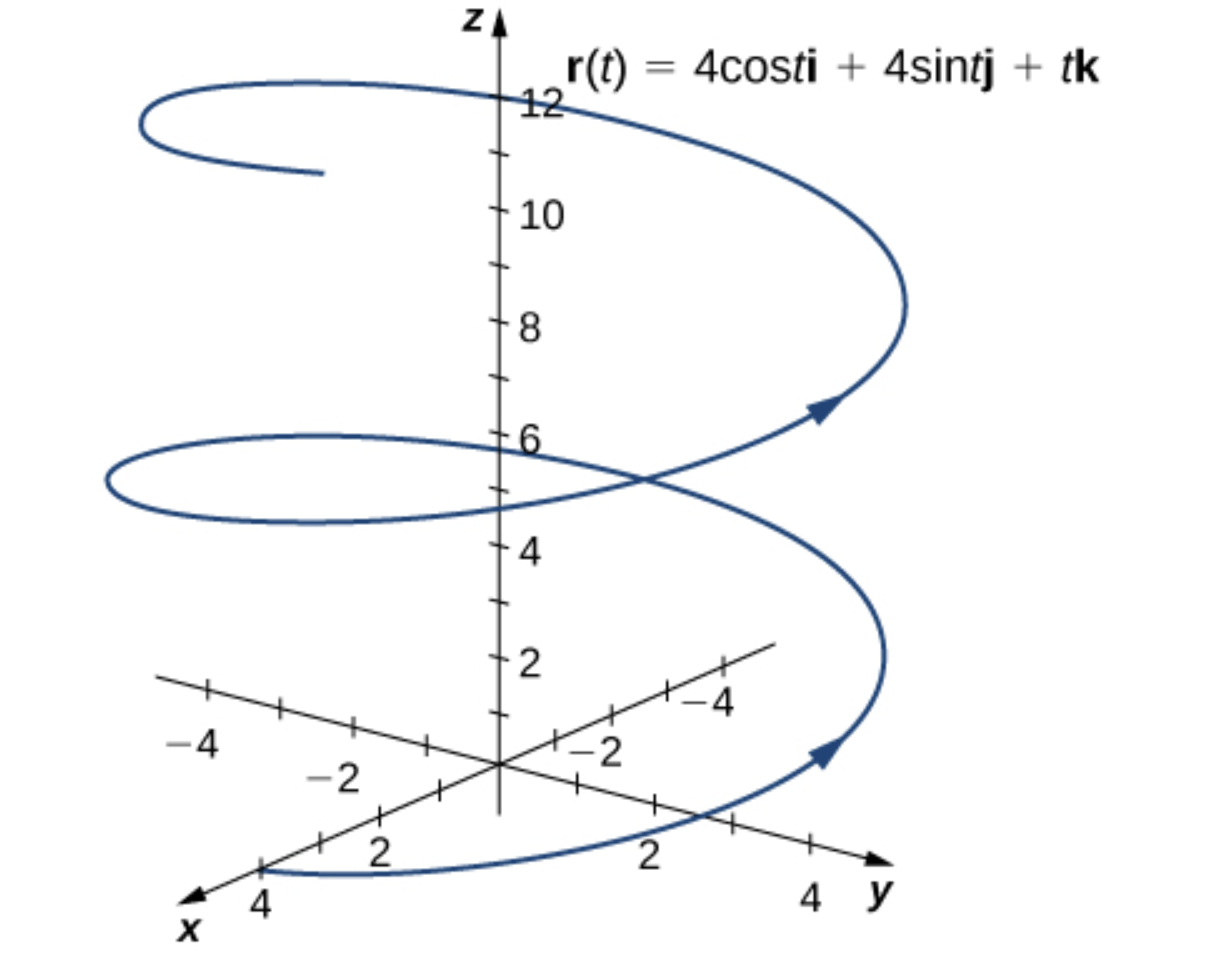
As we vary \(t\) over its allowed values, the vector-valued function \(\mathbf{r}(t)\) traces a curve in \(\R^n\text{.}\) We will not graph functions by hand in this course. For example, consider
\begin{equation*}
\mathbf{r}(t) = 4 \cos t \mathbf{i} + 4 \sin t \mathbf{j} + t \mathbf{k}, \quad 0 \leq t \leq 4\pi\text{.}
\end{equation*}
The figure shows \(x\text{,}\)\(y\text{,}\) and \(z\) axes with a blue curve spiraling upward around the vertical \(z\)-axis. Arrowheads on the curve indicate the direction of increasing parameter value. A label near the top gives the formula \(\mathbf{r}(t)=4\cos t\,\mathbf{i}+4\sin t\,\mathbf{j}+t\mathbf{k}\text{.}\)
Activity3.2.4.Evaluating a vector-valued function (U3-LO1).
Recall the vectors \(\mathbf{i}\) and \(\mathbf{j}\) in \(\R^2\) from Definition 1.3.14. Consider the vector-valued function \(\mathbf{r}: \R \to \R^3\) defined by the equation
Definition3.2.5.Limit of a Vector-Valued Function.
A vector-valued function \(\mathbf{r} : \mathbb{R} \to \mathbb{R}^n\) approaches the limit \(\mathbf{v} \in \mathbb{R}^n\) as \(t\) approaches \(a\text{,}\) written
That is, a vector-valued function is continuous at point \(t = a\) when the limit of the function as \(t\) approaches \(a\) equals the value of the function at \(a\text{.}\)
A vector-valued function \(\mathbf{r}: \R \to \R^n\) with component functions \(r_1, \dots, r_n\) is continuous at \(t = a\) if and only if each of the component functions \(r_1,\dots,r_n\) is continuous at \(t = a\text{.}\)
provided the limit exists. If \(\mathbf{r}'(t)\) exists, then we say \(\mathbf{r}\) is differentiable at \(t\text{.}\) If \(\mathbf{r}'(t)\) exists for all \(t\) in an open interval \((a,b)\text{,}\) then we say \(\mathbf{r}\) is differentiable on \((a,b)\text{.}\) The vector \(\mathbf{r}'(t)\) is called the tangent vector of the curve described by the function \(\mathbf{r}\) at the point \(\mathbf{r}(t)\text{.}\)
As in single variable calculus, we will often have much more efficient methods of calculating the derivative of a function \(\mathbf{r}\text{.}\) But you should be able to work directly from the definition in simple examples.
and it suffices to calculate the limits as \(\Delta t \to 0\) for each component. For \(\Delta t \neq 0\text{,}\) expanding and canceling out like factors gives that
Since Theorem 3.2.6 tells us taking limits of functions from \(\R\) to \(\R^n\) is equivalent to taking the limits of each component function, taking the derivative of such a function is equivalent to taking the derivative of each component function.
If \(\mathbf{r}: \R \to \R^n\) has components \(r_1,\dots,r_n: \R \to \R\text{,}\) then \(\mathbf{r}\) is differentiable at \(t\) if and only if each component function \(r_1,\dots,r_n\) is differentiable at \(t\text{,}\) and
If \(\mathbf{r}: \R \to \R^n\text{,}\) then \(\mathbf{r}': \R \to \R^n\) is also a vector-valued function of the same type, so we can consider the second derivatives \(\mathbf{r}''\text{,}\) i.e., the derivative of the function \(\mathbf{r}'\text{.}\)